Penny Ante Racing

main

about

cars

calendar

links


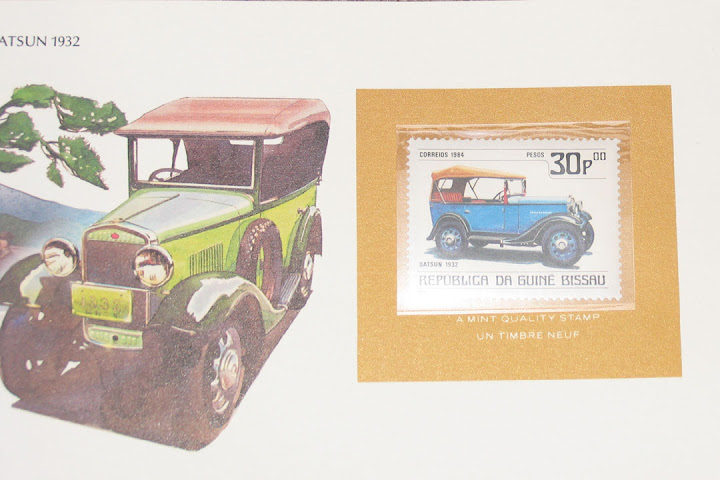
When I tell people that I am building a replica of a 1932 Datsun phaeton, it usually causes a few raised eyebrows. That's followed by several questions. Here are answers to those questions and a few others.

There were Datsuns in 1932?

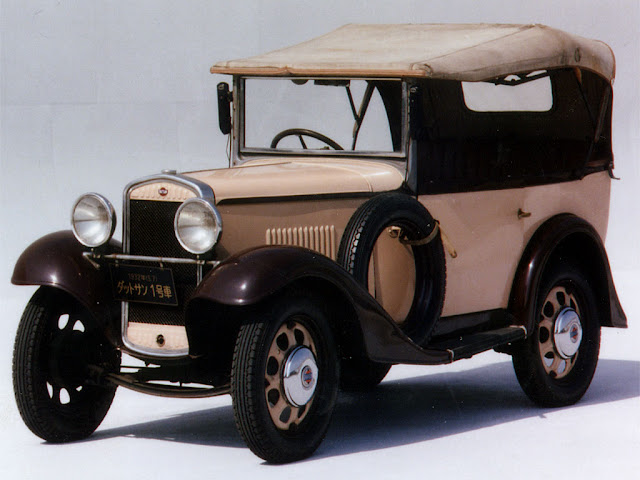
Yes. In the 1930s, Japan allowed micro cars to be driven without a licence(JSAE, Nissan, Madely, Togo pg. 11). During this time the DAT company - a manufacturer of full-size cars and trucks - decided to produce a micro-car to sell in this emerging market. They called it the "datson"; i.e. the little son of the normal DAT cars. This was quickly changed to "datsun" because the original name had some negative connotations in the Japanese language. (The Nissan Heritage Museum, source of this picture, has more details)

The first prototype was called the "DAT-91". It had a 500 cc, 10 hp engine, and a top speed of around 35 mph[]. If you look at the DAT-91 photo you can see the following design details:

  • Wide rear fenders
  • No runningboard
  • single-piece windshield that is curved at the bottom
  • no bar between the headlights
  • jumping rabbit (OK, hare) hood ornament
  • horizontal louvers in side of engine bay
  • doors that curve at the back to accomodate the wheels

How many datsuns were sold in 1932?

JSAE says:
ModelProducedWhen
1010either 1931(JSAE) or 1932(Nissan)
111501932
12???1933

I don't know how valid that is.

The 1930s Datsuns look a lot like an Austin Seven. Were they a copy of the British Car?

Probably not. On one hand, 1932 datsuns were similar to the 1929 Austin Seven Chummy, and the DAT & Tobata companies had access VERY detailed schematics and explanations of the Austin seven body, drive train and chassis. Of course, every car maker had this; one of Austin's engineers had made this information publicly available. (Madely, p.20). On the other hand, when Herbert Austin was purchased a Type 14 in 1934 and brought it to the UK for his engineers to examine (he was concerned about possible patent infringement), he didn't take any legal action against datsun. This seems to indicate that the cars were not similar enough to prove copying. The datsun Herbert Austin purchased is now housed in a museum in Hampshire, UK.[picture here]

Were there any 1930s licencing agreements between Austin Motors and Nissan?

I have no idea, but it seems unlikely. Madely's paper includes quotes from several authors who say there were licencing agreements between the two companies (Madely, pg. 23-24). He follows this up by listing an equal number of authors who say there were no licencing agreements (Madely, pg. 23-24). The most interesting of these is the following passage a 1997 article by Sharratt[z]:

  • Nissan also emphasises: "Nissan did not use any Austin engines, chassis or other mechanical parts in pre-war Datsuns. Nor did Nissan have any kind of licensing agreement with the Austin Motor Company before the Second World War."
This is claim is bolstered to some extent by the the Toyota Automobile Museum's statement that the Austin Seven "was imported to Japan and was as popular as the prewar Datsuns." Surely, if datsuns were licenced austins this would have warranted mention.

Were DAT/datsun DAT-bodies mounted on imported Austin (or other) chassis and running gear?

No. Yanase Motor and Nihon Jidosha Corporation produced the body, and the engine and chassis were made by Tobata Casting (what would become Nissan.) [JSAE]. Hashimoto did get his start in car manufacture in 1913 by purchasing two english made Swift car chassis. By the end of 1913, however, he was building both the chassis and the bodies of cars. They had plenty of experience building both vehicles and their chassis by the time the Datson/Datsun cars were created.[Madely]

Is there a specific austin model they resemble most?

The Type-91 looks a lot like the 1929 Austin Seven Chummy but had a smaller (500 cc) engine than any of the austin sevens that were produced (Motorsnippets.) The 1932/1933 Type 12 Phaeton - the car I'm building a replica of - has the same wheelbase and engine displacement as a 1929 austin seven saloon, but the way the rear fenders/doors meet is more like a 1933 American Austin Bantam or 1929 RK type Saloon. The front fenders look like a 1937-1939 Austin Ruby. The running board tapers to towards the narrow rear fender, a feature the datsun shared with MANY austins.

What Datson/Datsun models were produced between 1931-1933?

That's a sticky question. All the sources I have seen agree that the datsun produced the Type 11 during 1932. (They differ, however, in what the call a Type 11...see photos below.) The The type 12 - which may or may not have looked like the type 11 - was produced in 1933.(JSAE). I've given up trying to figure out which car in which museum is which model. All I can say with certainty is that the cars differ from one another in the following ways:
  • The angle of the front lip below grill shell
  • The shape of the front fenders
  • The type of door hinges
  • The position of the door hinges
  • The orientation of the louvers on the side of the engine bay
  • The degree of rake in the windshield
  • The type of metalwork on the door/side

Car
Features
Some museums have called this type of body a 1932 Type-11 (here and here). Others call it a 1933 Type-12. The car's front fenders have sides on them (like a 1934 ford), the metal lip below the grill is nearly horizontal, the door has simple 3-part hinges, and the bead rolled along the top of the door is lacks any ornamentation. You can view larger versions of this picture on the car's page at the Nissan Heritage Museum
This car is identified as a 1932 Type 11. Unlike the car above, it has simpler fenders without sides (like a Model-T), the metal lip below the grill is nearly vertical, a hinge made of more parts, and some ornate metalwork on the door. This picture is from Classic Car Base, where they have a larger version and several other pictures of this car. Unfortunately, the pictures don't always show up, so I have mirrored them here.
The car in this grainy photo has a slanted windshield, suicide doors, a metal lip below the grill that is at an angle (neither verticle or horizontal), fenders without sides. It is described here as a Type 12 even though it bears little resemblance to the car at the top which Nissan calls a Type 12.
I haven't found a picture of the Type 10 This car was designed by Goto Takashi(link), but sources differ as to when it was built. The RatDat and JSAE say 1931, but the Datsun History website Datsun History site mentions a Type 10 roadster from 1932. It may be that this is the production name for the DAT-91. That would explain why some sources say the type 10 has horizontal louvers in the side of the engine bay.
I haven't found a picture of the "Type II"A few sources mention a "Type-II" datsun, but the only illustration that I've found which is supposed to be this car appears to actually be a picture of a Type 12 Phaeton. This is pure conjecture, but I doubt that a "Type-II" was ever produced. Instead, I suspect that someone made a mistake when discussing the Type-11 (type eleven) and that mistake has been repeated by others.

What body styles were available for the 1932 and 1993 Datsun?

Newsfinder says that the 1932 Datsun was available as a roadster, tourer and sedan. JSAE says that the in 1933 "The range of available body options was also widened to include a 4-passenger sedan, coupe, phaeton, roadster, light van and truck."

What engine options existed for the 1931, 1932, and 1933 datsuns?

In 1931 and 1932, the engines were 495 cc; i.e. just barely under the 500 cc legal limit for cars that don't require a licence. That engine was 10 hp. When that limit was raised in 1933, the displacement for datsun was raised to 750 cc (12 hp).

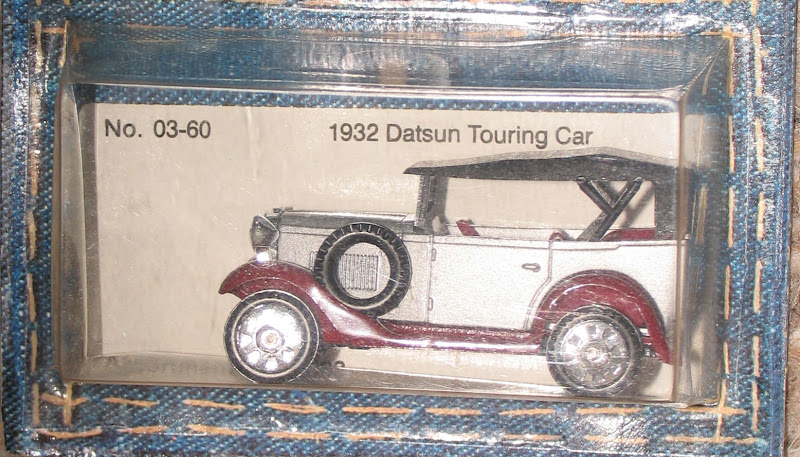
What specific features of the 1932 Datsun Phaeton will be incorporated into the replica you are building?

Design details:
  • side mirrors are vertical rectangles
  • convertable top is much wider than windshield, covering the side mirrors
  • rectangular windshield with a bottom that DOES NOT CURVE
  • very narrow rear fenders
  • Running boards that taper towards the rear fenders
  • Vertical louvers in the side of the engine compartment
  • metal lip below grill is nearly horizontal
  • back of door curves to accomodate fender arch
  • straight headlight bar

Unanswered questions:

  • Were other versions of the Type 12 made? - (e.g. roadster, saloon, etc.)
  • What years was the Type 12 produced? - We know that the car in the Nissan collection was built in 1933(link), and some sources say this is when production of the type 12 began(link), but the most common photographs of a "1932 datsun" are of tan-and-brown phaetons with the distinctive type-12 fenders[(link)][(link)][(link)]
  • What colors of the Type 12 were available? - EVERY photo of the Type 12 Phaeton appears to be tan and brown. the Japanese Society of Automotive Engineers - doesn't agree with nissan about when production of the datsuns occured. They don't even agree with nissan about which type of car is located in the Nissan Heritage Collection in Zama. (Nissan says the car is a 1933 Type 12, and JSAE says it is a 1932 Type 11!!!) I don't know how valid they are, but these are the numbers listed on the JSAE website

References